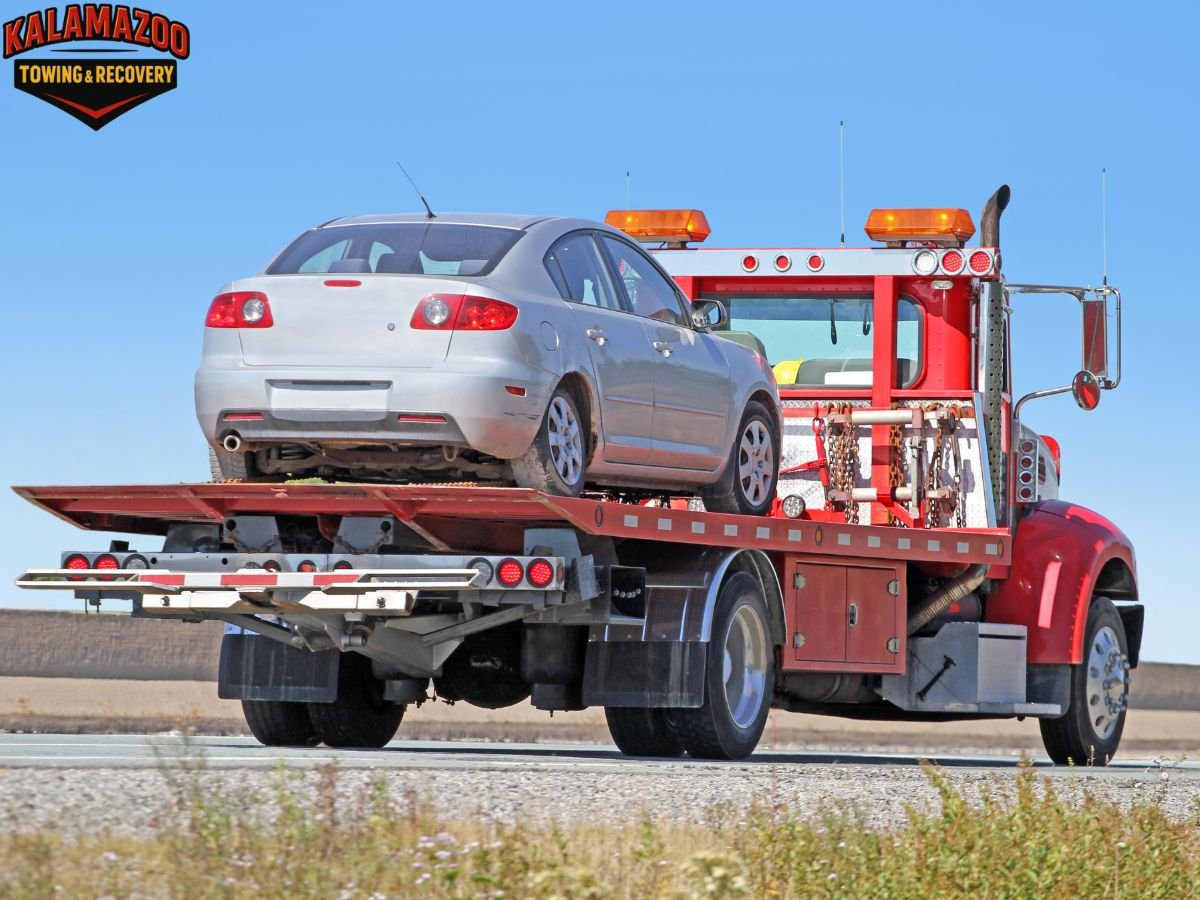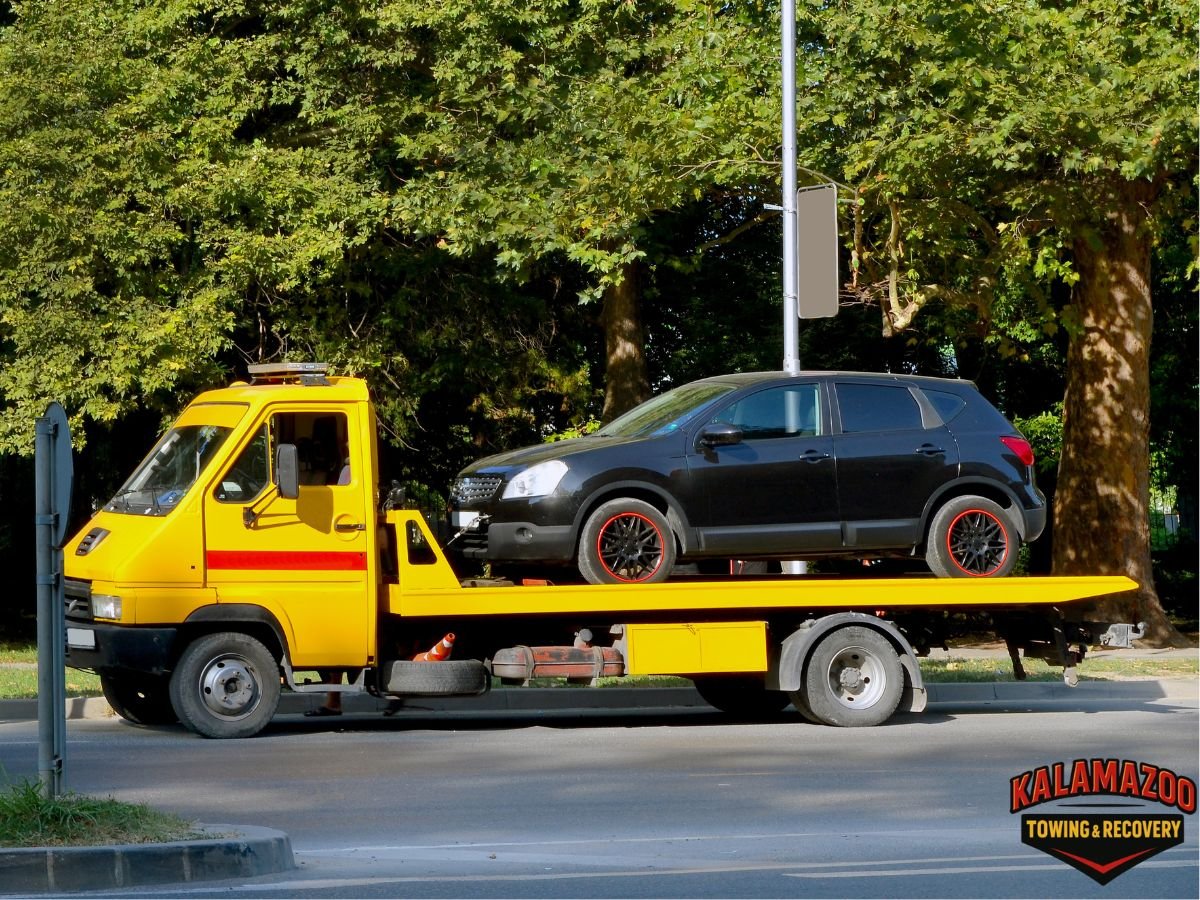
A crash compresses a lot of decisions into a short window, and most people make them while still shaking. Where the car goes, who moves it, and what comes out of it before it leaves are all settled in the first hour — usually by whoever speaks up first.
KZOO Towing has worked accident scenes across Kalamazoo County since 1999, alongside Michigan State Police and local agencies. This is what actually happens, in order, and where drivers most often lose money without realizing it.
Minutes One Through Five: People, Then Vehicles
- Check everyone. Yourself, your passengers, the other vehicle. Adrenaline hides injuries, and neck and back symptoms often show up hours later. If there is any doubt, call 911 and let medical make the call — not you, and not the other driver.
- Get out of the traffic lanes if you safely can. Michigan expects drivers to move vehicles out of the roadway after a minor crash when it is safe to do so. On I-94 between Oshtemo and Galesburg, a stopped car in a live lane is a second crash waiting to happen. If the vehicle will not move, get the people out and behind a barrier — not standing between the cars.
- Hazards on. Then call 911. Report the location as precisely as you can: mile marker, exit number, or cross street.
- Do not discuss fault. Exchange information and let the investigation and the insurers sort it out. Apologizing at the scene is human and can complicate a claim.
Minutes Five Through Twenty: Document Everything
Your phone is the most useful tool you have right now, and this is the only chance you get.
- All vehicles from several angles, wide and close.
- Final resting positions before anything moves.
- License plates, and the other driver’s insurance card and license.
- Skid marks, debris field, damaged guardrail or signs.
- Road conditions, weather, lighting, and any construction — relevant on Sprinkle Road and anywhere lanes have shifted.
- The responding officer’s name and the report or incident number.
Get the report number before you leave the scene. Insurers ask for it immediately, and tracking it down later is a chore.
Who Actually Chooses the Tow Company
This is the part most drivers do not know, and it matters.
In many situations you can request the operator you want. If your vehicle is drivable-but-damaged, or the scene is cleared and the decision is yours, you are entitled to say which company you would like to call.
Where that changes is when law enforcement orders the tow. If a vehicle is blocking traffic, if it is being held as part of an investigation, or if the driver cannot make decisions, the responding agency directs the removal — often through a rotation list. That is a legitimate process and it exists to clear roads quickly and safely.
The practical advice: if you are able to speak and the officer has not already ordered a rotation tow, say who you want. Nobody will offer. And be wary of any truck that turns up unrequested at a scene it was not dispatched to.
Before the Truck Leaves: Empty Your Car
Once your vehicle is in a storage yard, getting back to it means business hours, possibly a release, and possibly a fee. People forget this every single week.
Take with you: your registration and insurance documents, garage door opener, house keys, phone charger, prescriptions, glasses, laptop, wallet, child car seats, and anything in the trunk. Check the glovebox, the center console, under the seats, and the visors.
Car seats deserve a specific mention. A seat that was in a crash generally should not be reused, and manufacturers publish replacement guidance. Take it anyway — your insurer may cover a replacement and will want to see it.
Where Should It Go? Decide Now, Not Tomorrow
Here is the quiet cost. Storage fees accrue daily, and a car that sits in a yard for two weeks while people work out who is paying can generate a bill that rivals the tow itself.
You generally have options:
- Directly to your body shop. If you know where the car is going, say so at the scene and skip the storage step entirely. This is almost always the cheapest path.
- To your home, if the car is not leaking and you have somewhere safe to put it.
- To a storage yard, which is fine short term but starts a meter.
- To the insurer’s facility, once they have assigned one.
Call your insurer from the scene if you can. They will often tell you exactly where they want the vehicle, which removes the guesswork and the storage days.
Why We Have No Repair Shop — and Why That Helps You Here
KZOO Towing does not operate a body shop or a repair facility. We are towing, recovery, and roadside only.
At an accident scene that matters more than anywhere else. We have no financial interest in where your vehicle ends up, so there is no reason for us to steer it toward our own bays. Your car goes to the shop you choose, or the one your insurer specifies. If you have not decided yet, we will tell you what your options are rather than making the decision for you.
We also photograph vehicle condition before loading on every job. After a crash that record is genuinely valuable — it separates collision damage from anything that happens afterward, and insurers take it seriously.
The Kalamazoo County Roads Where This Happens Most
- I-94, Exit 72 through Exit 85 — Oshtemo through Comstock to Galesburg. Highway speeds, variable shoulder width, and the highest severity.
- US-131 — the north-south commercial route, with a different traffic mix and grade changes.
- Westnedge Avenue from Portage into downtown — heavy commercial frontage, constant turning movements, and a steady run of intersection collisions.
- Stadium Drive and the M-43 corridor near WMU, especially late at night.
- Sprinkle Road — construction zones and narrow shoulders leave nowhere safe to end up.
- Gull Road toward Richland — higher speeds, longer gaps between services, and a longer wait if your operator is not already positioned in the county.
Frequently Asked Questions
Can I choose my own tow company after a crash?
Often yes — say so before a decision is made for you. When police order a rotation tow because the vehicle is blocking traffic or is part of an investigation, the responding agency directs it.
How do I get my belongings out of an impounded car?
Much easier to take them at the scene. Afterward you are working around business hours and possible release requirements, so grab everything before the truck pulls away.
Who pays for accident towing?
It depends on your coverage and the circumstances. Michigan’s insurance system is its own animal, so confirm with your insurer. We provide itemized documentation for the claim either way.
How fast can you reach an accident scene?
Our average response across the county is under 30 minutes. We keep trucks positioned across Kalamazoo County rather than staged at one address.
What if my car rolled or went off the road?
That is a recovery rather than a straight tow, and it needs proper rigging and equipment. Tell the dispatcher what happened so the right truck comes out first.
Can you get my car straight to my body shop?
Yes, and it usually saves you money by skipping storage. Have the shop name and address ready when you call.
In a Crash in Kalamazoo County? One Call, 24/7.
A real dispatcher answers — no automated system, no hold queue. Licensed, DOT compliant, fully insured, with condition photos on every job and an upfront price before we hook up.
We work scenes with Michigan State Police and insurance carriers across Portage, Oshtemo, Comstock, Parchment, Galesburg, Vicksburg, Mattawan, Richland, and out along I-94 toward Battle Creek.
Call KZOO Towing at (269) 548-4665 — 24 hours a day, 365 days a year.
We’re at 2910 Business One Dr, Kalamazoo, MI 49048. Learn more about our vehicle recovery, flatbed towing, and winch-out service.
This article is general information and is not legal, medical, or insurance advice. If anyone is injured, seek qualified medical attention. Confirm coverage and claim requirements with your own insurer.